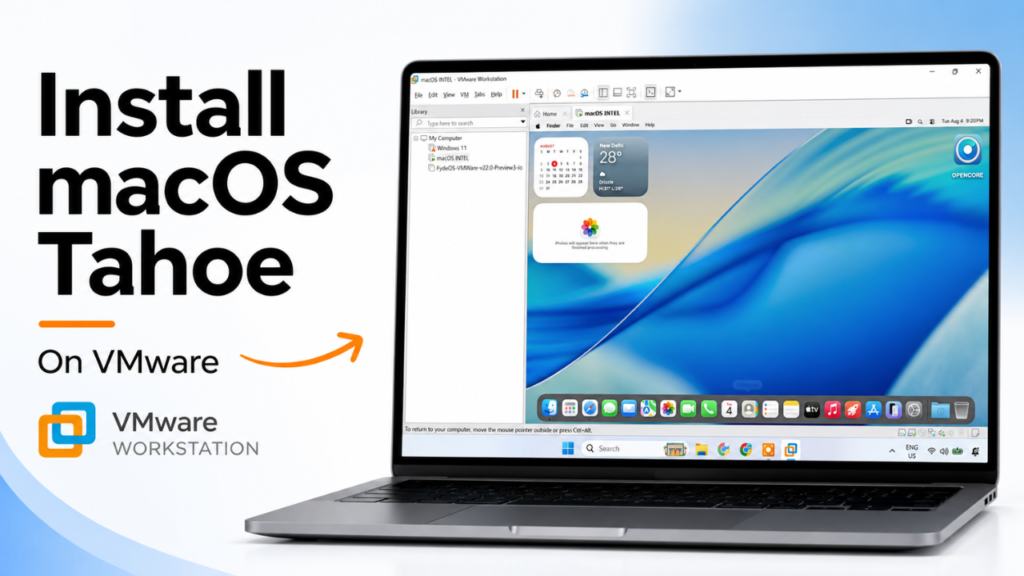
Do you want to try macOS but only have a Windows computer? Maybe you want to test macOS apps, explore the interface, or learn how Apple’s ecosystem works — without buying an expensive Mac. The good news is you can run macOS on your Windows PC using a virtual machine.
In this guide, I’ll show you step by step how to install macOS inside VirtualBox on a Windows computer. This method works on both Intel and AMD processors and is written for beginners, so you don’t need advanced technical knowledge. By the end of this tutorial, you’ll have a working macOS virtual machine running safely alongside Windows.
Let’s get started.
What You’ll Need Before We Start
Before installing macOS in VirtualBox, make sure your computer meets the basic requirements. Running macOS in a virtual machine is heavier than running normal software, so having enough hardware resources is important for smooth performance.
Here’s what you should have:
- A Windows 10 or Windows 11 PC (64-bit)
- Intel VT-x or AMD-V virtualization enabled in BIOS
- Minimum 8GB RAM (16GB recommended for better performance)
- At least 100GB of free storage space
- A stable internet connection for downloads
If virtualization is disabled in BIOS, VirtualBox will not work properly. To enable it, restart your PC, enter BIOS/UEFI settings, and turn on:
- Intel: Intel Virtualization Technology (VT-x)
- AMD: SVM Mode / AMD-V
Save changes and boot back into Windows.
Once your system is ready, we can download the required files and start the installation.
Download Required Files
Now we need to download the tools and files required for the macOS installation. There are three things you must download: VirtualBox, the VirtualBox Extension Pack, and the macOS ISO file.
Download VirtualBox
Open the VirtualBox downloads page and click Windows hosts. After downloading, run the installer and follow the on-screen instructions. You can keep all settings as default.
Download VirtualBox Extension Pack
On the same page, click All supported platforms to download the Extension Pack. Once downloaded, double-click the file and install it. This adds USB 3.0 support and improves compatibility.
Download macOS ISO (Big Sur Recommended)
Download macOS Big Sur or an earlier version. Newer versions like Ventura or Sonoma usually do not run properly in VirtualBox.
Once all files are downloaded and installed, we’ll disable Hyper-V to prevent conflicts and then create the virtual machine.
Disable Hyper-V (Very Important)
Before creating the macOS virtual machine, we must disable Hyper-V and Windows virtualization security features. If Hyper-V is enabled, VirtualBox may show errors, fail to boot macOS, or run extremely slow.
This step prevents conflicts between Microsoft’s virtualization system and VirtualBox.
Turn Off Memory Integrity
- Open Windows Security
- Go to Device Security
- Click Core isolation details
- Turn Memory Integrity OFF
- Restart your PC
Disable Hyper-V Using Command Prompt
After restarting:
- Open Command Prompt as Administrator
- Type the command below and press Enter:
bcdedit /set hypervisorlaunchtype off
- Restart your PC again
After this reboot, Hyper-V will be disabled and VirtualBox will work properly.
Now we’re ready to create the macOS virtual machine.
Create the macOS Virtual Machine in VirtualBox
Now we’ll create a new virtual machine that will run macOS. Take your time with these settings — correct configuration is important for a successful installation.
- Open VirtualBox
- Click New
A new window will appear.
- Enter a name for the VM
Example: macOS Big Sur - In the ISO Image field, click Browse and select your macOS ISO file
- Set:
- Type: Mac OS X
- Version: Mac OS X (64-bit)
Click Next
Allocate RAM and CPU
macOS needs decent hardware to run smoothly.
- Minimum: 4GB RAM + 2 cores
- Recommended: 8–12GB RAM + 4–6 cores
⚠️ Do NOT drag the slider past the green zone. Otherwise Windows will slow down.
Click Next
Create Virtual Storage
You must now allocate disk space for macOS.
- Minimum: 100GB
- Recommended: 120–150GB if you have space
Choose a size and click Finish
VirtualBox will now create the macOS virtual machine.
Next, we’ll adjust advanced settings to make macOS boot correctly.
Adjust Virtual Machine Settings (Important)
Before starting the VM, we need to change a few settings. These tweaks are required for macOS to boot properly inside VirtualBox.
Select your macOS VM in VirtualBox and click Settings.
System Settings
Go to the System tab → Motherboard
- Uncheck Floppy
- Chipset: ICH9
- Enable EFI (special OSes only)
Then go to the Processor tab:
- Make sure at least 2 CPUs are selected
- Keep the slider in the green zone
Display Settings
Go to Display
- Video Memory: 128 MB
- Enable 3D Acceleration
This improves graphics performance and prevents display glitches.
Network Settings (Optional)
Go to Network
- Adapter 1: leave default (NAT works fine)
- Adapter 2 (optional backup):
- Enable Adapter
- Select Bridged Adapter
- Choose your Wi-Fi or Ethernet card
This helps if internet doesn’t work inside macOS.
USB Settings
Go to USB
- Select USB 3.0 (xHCI) Controller
This improves compatibility with USB devices.
Click OK to save all settings.
Next, we’ll patch the virtual machine using special Intel/AMD commands so macOS can boot.
Patch the Virtual Machine (Intel & AMD)
Now we must patch the virtual machine using special VirtualBox commands. Without this step, macOS will not boot.
⚠️ Important:
- Close VirtualBox completely before running the commands
- Do NOT keep it running in the background
- Replace “VM Name” with the exact name of your VM
Open Command Prompt as Administrator.
If You Have an Intel Processor
Copy and paste these commands one by one:
cd "C:\Program Files\Oracle\VirtualBox\"

VBoxManage.exe modifyvm "VM Name" --cpuidset 00000001 000106e5 00100800 0098e3fd bfebfbff

VBoxManage setextradata "VM Name" "VBoxInternal/Devices/efi/0/Config/DmiSystemProduct" "iMac19,3"
VBoxManage setextradata "VM Name" "VBoxInternal/Devices/efi/0/Config/DmiSystemVersion" "1.0"
VBoxManage setextradata "VM Name" "VBoxInternal/Devices/efi/0/Config/DmiBoardProduct" "Iloveapple"
VBoxManage setextradata "VM Name" "VBoxInternal/Devices/smc/0/Config/DeviceKey" "ourhardworkbythesewordsguardedpleasedontsteal(c)AppleComputerInc"
VBoxManage setextradata "VM Name" "VBoxInternal/Devices/smc/0/Config/GetKeyFromRealSMC" 0

VBoxManage setextradata "VM Name" "VBoxInternal/TM/TSCMode" "RealTSCOffset"
If You Have an AMD Processor
Use these commands instead:
cd "C:\Program Files\Oracle\VirtualBox\"

VBoxManage.exe modifyvm "VM Name" --cpuidset 00000001 000106e5 00100800 0098e3fd bfebfbff

VBoxManage setextradata "VM Name" "VBoxInternal/Devices/efi/0/Config/DmiSystemProduct" "iMac19,3"
VBoxManage setextradata "VM Name" "VBoxInternal/Devices/efi/0/Config/DmiSystemVersion" "1.0"
VBoxManage setextradata "VM Name" "VBoxInternal/Devices/efi/0/Config/DmiBoardProduct" "Iloveapple"
VBoxManage setextradata "VM Name" "VBoxInternal/Devices/smc/0/Config/DeviceKey" "ourhardworkbythesewordsguardedpleasedontsteal(c)AppleComputerInc"
VBoxManage setextradata "VM Name" "VBoxInternal/Devices/smc/0/Config/GetKeyFromRealSMC" 0

VBoxManage modifyvm "VM Name" --cpu-profile "Intel Core i7-6700K"
VBoxManage setextradata "VM Name" "VBoxInternal/TM/TSCMode" "RealTSCOffset"
After running the commands successfully, do not open VirtualBox yet.
Next, we’ll start the VM and install macOS.
Install macOS Inside VirtualBox
Now we’re finally ready to install macOS.
- Open VirtualBox
- Select your macOS VM
- Click Start
The first boot may take a few minutes. Be patient — this is normal.
Format the Virtual Disk
When the macOS installer screen appears:
- Select your language → click the arrow
- Choose Disk Utility → Continue
- Select VBox HardDisk Media
- Click Erase
Enter:
- Name:
Macintosh HD(or anything you like)
Then click Erase
After formatting:
- Close Disk Utility
Install macOS
- Click Install macOS Big Sur
- Click Continue
- Agree to the terms
- Select the disk you just erased
- Click Install
The installation will take 30–45 minutes.
During installation:
- The VM will reboot several times
- Do NOT close VirtualBox
- Just let it run
When installation finishes, macOS setup will start.
Follow the on-screen instructions just like setting up a new Mac:
- Region
- Keyboard
- Apple ID (optional)
- User account
After setup completes, you’ll reach the macOS desktop.
💡 First boot tip: Let macOS sit idle for a few minutes. It finishes background setup and becomes smoother after that.
Next, we’ll increase the display resolution and video memory.
Increase Screen Resolution & Video Memory
By default, macOS inside VirtualBox runs at a low resolution (usually 1024×768). We can manually increase the resolution and video memory for a better experience.
First, power off your macOS virtual machine completely.
Then open Command Prompt as Administrator.
Set Higher Display Resolution
Run the following command:
cd "C:\Program Files\Oracle\VirtualBox\"
VBoxManage setextradata "VM Name" VBoxInternal2/EfiGraphicsResolution 1920x1080
Replace “VM Name” with your VM name.
Choose a resolution that matches or is lower than your monitor:
- 1280×720 (HD)
- 1920×1080 (Full HD)
- 2560×1440 (QHD)
- 3840×2160 (4K)
Increase Video Memory
Now run:
cd "C:\Program Files\Oracle\VirtualBox\"
VBoxManage modifyvm "VM Name" --vram 256
This increases VRAM from 128MB to 256MB for smoother graphics.
Start the VM Again
Start the macOS VM. You should now see the higher resolution.
To switch to full-screen mode:
View → Full-screen Mode
Use the same option again to exit full-screen.
Next, we’ll add troubleshooting tips in case something doesn’t work.
Troubleshooting & Common Fixes
If macOS doesn’t install or gets stuck, don’t worry — most problems have simple fixes. Here are the most common issues and how to solve them.
VM Stuck at Apple Logo / Boot Loop
This usually happens because of virtualization conflicts.
Fix:
- Make sure Hyper-V is disabled
- Restart your PC after running the command
- Ensure Enable EFI is checked in VM settings
- Use macOS Big Sur or older, not Ventura/Sonoma
VT-x / AMD-V Not Available Error
This means virtualization is disabled in BIOS.
Fix:
- Restart PC → Enter BIOS/UEFI
- Enable Intel VT-x or AMD SVM Mode
- Save and reboot
macOS Running Very Slow
macOS needs more resources than Windows VMs.
Fix:
- Increase RAM and CPU cores (stay in green zone)
- Use SSD storage if possible
- Let macOS idle for 3–5 minutes after boot
- Close heavy apps in Windows
No Internet Inside macOS
Fix:
- VM Settings → Network
- Adapter 1 = NAT
- If still broken, use Bridged Adapter
Black Screen After Installation
Fix:
- Power off VM
- Start again
- If still black, increase VRAM to 256MB
- Recheck patch commands
Final Words
If you followed every step carefully, macOS should now run inside VirtualBox on your Windows PC. You can explore macOS apps, test software, or simply learn the Apple environment — all without buying a Mac.
If you get stuck at any step, note exactly where the issue happens and troubleshoot from there. Most problems are caused by missed settings or Hyper-V conflicts.
Enjoy your macOS virtual machine!